When people think about dry or irritated eyes, they often blame screens, lack of sleep, allergies, or dehydration. But there is another important part of the eye that is easy to overlook: the meibomian glands.
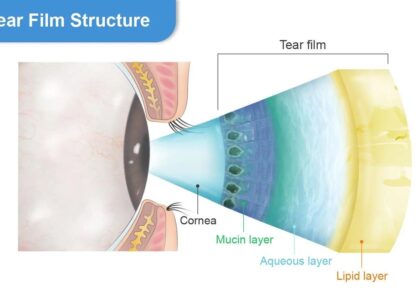
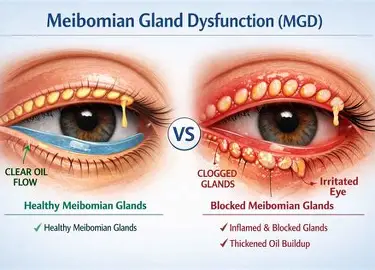
These tiny glands are located inside the eyelids and produce an oily substance called meibum. This oil forms part of the tear film and helps slow the evaporation of tears from the surface of the eye. When these glands become blocked or do not function properly, the tear film can become unstable and symptoms of dry eye may develop.
This condition is known as Meibomian Gland Dysfunction (MGD).
What Exactly Are Meibomian Glands?
Your eyelids contain numerous small oil-producing glands. Their job is closely connected with the health of the tear film.
Every time you blink, the eyelids help distribute the tear film across the surface of the eye. The meibomian glands contribute the lipid layer that helps prevent tears from evaporating too quickly.
According to the American Academy of Ophthalmology’s EyeWiki, changes in the quantity or quality of meibomian gland secretions can affect tear-film stability and contribute to ocular-surface symptoms.
This means that healthy tears are not simply about producing enough watery fluid. The quality and stability of the entire tear film matter too.
What Happens When These Glands Stop Working Properly?
In MGD, the glands may become blocked, produce altered secretions, or gradually lose function.
When less oil reaches the tear film, tears can evaporate more quickly. This may leave the surface of the eye exposed to irritation.
Some people experience obvious symptoms, while others may have gland changes without realizing that anything is wrong.
Common symptoms can include:
- Burning or stinging
- Dryness
- Gritty or sandy sensation
- Redness
- Watery eyes
- Blurred or fluctuating vision
- Eye fatigue
- Sensitivity to light
- Discomfort when wearing contact lenses
Interestingly, watery eyes can occur alongside dry eye symptoms. The eye may respond to irritation by producing reflex tears, even though the normal tear film remains unstable.
Why Can Dry Eyes Become Watery?
This is one of the less intuitive aspects of ocular surface problems.
When the surface of the eye becomes irritated, the nervous system can trigger additional tear production. These reflex tears do not necessarily provide the same long-lasting protection as a stable tear film.
The result can be a confusing combination:
Dryness + irritation + excessive watering.
So, constantly watery eyes do not always mean that the eyes are adequately lubricated.
What Causes Meibomian Gland Dysfunction?
MGD can have multiple contributing factors rather than one single cause.
Age is an important factor, and gland function can change over time. Other associations include certain inflammatory or systemic conditions, contact lens use, some medications, eyelid disorders, and changes in blinking.
Environmental conditions may also aggravate ocular-surface discomfort.
For people who spend long periods concentrating on close-up tasks, reduced blinking can potentially contribute to an unhealthy tear-film environment. The meibomian glands are mechanically influenced by eyelid movement and blinking.
Your Blink Is More Important Than You Think
Blinking may look like an insignificant automatic movement, but it plays an important role in the ocular surface.
The National Eye Institute reports that people typically blink around 15–20 times per minute.
Research funded by the National Eye Institute has also examined the complex muscle activity involved in blinking and eyelid movement, highlighting that a blink is more complicated than simply opening and closing the eyelids.
This is one reason the health of the eyelids deserves more attention when discussing dry-eye symptoms.
Can Nutrition Influence Meibomian Gland Health?
Nutrition is another area being studied in relation to ocular-surface health.
Nutrients involved in eye health include vitamin A, vitamin D, vitamin C, vitamin E, omega-3 fatty acids, lutein, and zeaxanthin. However, nutritional needs differ between individuals, and supplements should not automatically be considered a treatment for an eye disorder.
A balanced diet containing vegetables, fruits, legumes, nuts, seeds, whole grains, and appropriate sources of protein is a sensible foundation for overall health.
For example, leafy green vegetables provide carotenoids such as lutein and zeaxanthin, which are concentrated in the retina and macula.
You can also read our article on healthy nutrition and everyday wellness at My Medi Times.
Why Omega-3 Supplements Should Not Be Treated as a Universal Answer
Omega-3 fatty acids are frequently promoted for dry-eye problems. While they have been investigated for ocular-surface health, the evidence does not mean that everyone with dry eyes should automatically take an omega-3 supplement.
Your diet, existing medical conditions, medications, and nutritional status all matter.
It is better to discuss supplements with a healthcare professional rather than taking high-dose products based solely on an online recommendation.
How Is MGD Diagnosed?
MGD cannot always be diagnosed simply by asking whether someone has dry eyes.
An eye-care professional may examine:
- The eyelid margins
- The openings of the meibomian glands
- The quality of gland secretions
- Tear-film stability
- The ocular surface
- Tear production
- Signs of inflammation
- The structure of the glands
Specialized imaging known as meibography can also be used to examine the structure and possible loss of meibomian glands.
This is important because someone can have meibomian gland changes even when symptoms are relatively mild.
What Can Help Manage MGD?
Management depends on the underlying problem and its severity.
Eye-care professionals may recommend approaches such as:
- Eyelid hygiene
- Warm compresses
- Gentle eyelid care
- Artificial tears when appropriate
- Treatment of associated eyelid inflammation
- Management of contributing medical conditions
- Specific prescription treatments when necessary
Warm compresses are commonly used because heat can help soften thickened gland secretions and support their release. EyeWiki describes warm compresses and eyelid care as important components of MGD management.
However, persistent symptoms should be evaluated rather than repeatedly treating them at home without knowing the underlying cause.
When Should You See an Eye Specialist?
Occasional dryness after a long day is different from persistent ocular discomfort.
Consider professional evaluation if you experience:
- Recurrent eye burning
- Persistent redness
- Frequent watering
- Repeated episodes of blurred vision
- Difficulty wearing contact lenses
- Chronic gritty sensation
- Persistent eyelid irritation
- Eye pain
- Significant changes in vision
A comprehensive eye examination can identify problems that may not be obvious from symptoms alone. The National Eye Institute notes that comprehensive dilated eye examinations can detect certain eye problems before noticeable vision changes occur.
MGD Is More Than “Just Dry Eyes”
One of the biggest reasons MGD deserves more attention is that it demonstrates how complicated dry-eye disease can be.
The problem may not simply be a lack of water in the eyes. The oil-producing glands, tear film, eyelids, ocular surface, nerves, inflammation, environment, and other factors can interact.
That is why repeatedly using eye drops without understanding why symptoms are occurring may not address the underlying problem.
A Better Way to Think About Eye Comfort
Instead of thinking about eye health as simply “Do I have enough tears?”, consider the bigger picture:
Are my tears stable?
Are my eyelids functioning normally?
Are the oil-producing glands healthy?
Is the ocular surface comfortable?
Are there signs of inflammation?
These questions can provide a more complete understanding of persistent eye discomfort.
Final Thoughts
Meibomian Gland Dysfunction is a lesser-known contributor to dry-eye symptoms, but the tiny glands involved play an important role in maintaining the tear film.
Understanding the relationship between the eyelids, meibomian glands, tears, and ocular surface can help explain why some people experience dryness, burning, blurred vision, or even excessive watering.
Good nutrition, appropriate eyelid care, healthy lifestyle habits, and professional eye examinations can all form part of a broader approach to maintaining eye health.
If symptoms are persistent, painful, or affecting your vision, speak with an eye-care professional rather than assuming they are simply caused by screen time or tiredness.
For more evidence-based health and wellness information, visit My Medi Times – Health is Wealth.